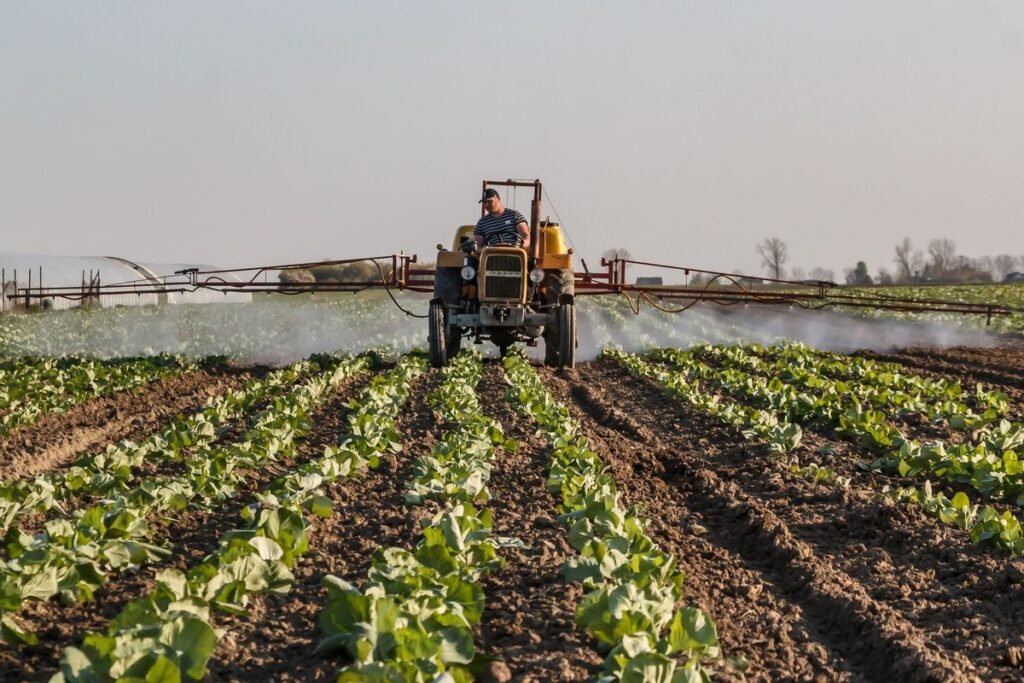
What field efficiency should I use for spraying? Use 55 to 65 percent for a small or irregular field, 70 to 75 percent for an average field, 80 to 85 percent for a large rectangular field, and 85 to 90 percent for an ideal field with GPS guidance. Those figures cover turns and overlaps while spraying.
What Field Efficiency Should I Use for Spraying by Field Shape and Size
Field efficiency is the share of the theoretical rate that you actually achieve while spraying. Theoretical acres per hour is boom width in feet times speed in miles per hour divided by 8.25, with no time lost to turns, overlaps, headlands or slowing down. Acres per hour equals boom width times speed times efficiency divided by 8.25. The constant 8.25 equals 43560 divided by 5280.
The site bands for spraying are 55 to 65 percent for small or irregular fields, 70 to 75 percent for average fields, 80 to 85 percent for large rectangular fields, and 85 to 90 percent for ideal fields with GPS guidance. The ideal band is 85 to 90 percent, never 88 to 90 percent. Use the low end when the field works against you, and the high end only when it helps you.
The table below shows what the bands mean for a 60 foot boom at 10 miles per hour. The theoretical rate is 60 times 10 divided by 8.25, which equals 72.73 acres per hour. Every rate in the table is that rate times the efficiency in the same row, worked from the unrounded rate. Use the understanding field efficiency guide for the general bands.
| Field type | Efficiency | Acres per hour at 60 ft and 10 mph |
|---|---|---|
| Small or irregular, low end | 55 percent | 40.00 |
| Small or irregular, high end | 65 percent | 47.27 |
| Average, low end | 70 percent | 50.91 |
| Average, high end | 75 percent | 54.55 |
| Large rectangular, low end | 80 percent | 58.18 |
| Large rectangular, high end | 85 percent | 61.82 |
| Ideal with GPS guidance, high end | 90 percent | 65.45 |
How Spraying Efficiency Differs From Refill Inclusive Effective Efficiency
Spraying efficiency and refill inclusive effective efficiency are two different figures. Spraying efficiency covers time lost while spraying, including turns, overlaps, headlands and slowing down. It does not cover filling the tank, mixing product, traveling to water, or waiting for a tender. Refill inclusive effective efficiency covers both, so it is always lower.
Work it out in three steps. First, acres per tank equals tank gallons divided by GPA, where GPA is gallons per acre. Second, spraying time per tank equals acres per tank divided by acres per hour while spraying, times 60 for minutes. Third, add refill minutes for the cycle, then divide acres per tank by cycle hours for real output.
90 foot example: 90 x 12 x 0.85 / 8.25 = 111.27 acres per hour while spraying. A 1000 gallon tank at 15 GPA covers 66.67 acres per tank, because 1000 / 15 = 66.666667. Spraying time is 66.666667 / 111.272727 = 0.599138 hours, or about 36 minutes. Add 20 minutes per refill, and the cycle is about 56 minutes. Real output is 66.666667 / 0.932462 hours = 71.5 acres per hour. Theoretical rate is 90 x 12 / 8.25 = 130.91 acres per hour. Effective efficiency is 71.50 / 130.91 = 0.546, or about 55 percent.
60 foot example: 60 x 10 x 0.80 / 8.25 = 58.18 acres per hour while spraying. A 1200 gallon tank at 10 GPA covers 120 acres per tank, because 1200 / 10 = 120. Spraying time is 120 / 58.181818 = 2.0625 hours, or 124 minutes. Add 15 minutes per refill, and the cycle is 139 minutes. Real output is 120 / 2.3125 hours = 51.9 acres per hour. Theoretical rate is 60 x 10 / 8.25 = 72.73 acres per hour. Effective efficiency is 51.89 / 72.73 = 0.714, or about 71 percent.
A short check shows why a rounded rate can mislead you. A 20 acre field at 2.45 acres per hour takes about 8.2 hours, never 8.1 hours, because the unrounded rate gives 8.15 hours. Work from unrounded rates, and round only at the end. Run your own numbers through the spraying acres per hour calculator, and read the how to calculate acres per hour guide for the formula in full.
Efficiency by Sprayer Type and Tank Logistics
Sprayer type changes both parts of the figure. A wide boom at speed gives a high spraying rate, but a small tank relative to that rate means frequent refills, so effective efficiency falls fast. A narrow boom gives a low spraying rate, but a tank that covers many acres means long runs between refills.
The table below gives refill inclusive effective efficiency as a worked figure for each sprayer type in the verified table. The spraying rate in each row is the verified rate for that sprayer type. Tank size, application rate and refill minutes are labelled example inputs, not standard values, because they vary by job and by product label.
| Sprayer type | Spraying rate | Acres per tank | Spraying minutes per tank | Refill minutes | Real output | Effective efficiency |
|---|---|---|---|---|---|---|
| ATV or UTV sprayer, 15 ft at 6 mph and 70 percent | 7.64 | 10 | 79 | 10 | 6.77 | 62 percent |
| 3 point or pull type, 40 ft at 8 mph and 75 percent | 29.09 | 20 | 41 | 15 | 21.33 | 55 percent |
| Pull type, 60 ft at 10 mph and 80 percent | 58.18 | 120 | 124 | 15 | 51.9 | 71 percent |
| Self propelled, 90 ft at 12 mph and 85 percent | 111.27 | 66.67 | 36 | 20 | 71.5 | 55 percent |
| Self propelled, 120 ft at 14 mph and 85 percent | 173.09 | 100 | 35 | 20 | 109.8 | 54 percent |
ATV or UTV example: a 100 gallon tank at 10 GPA gives 10 acres per tank, with 10 minutes per refill. Spraying time is 10 / 7.636364 = 1.309524 hours, or about 79 minutes. The cycle is about 89 minutes, and real output is 10 / 1.476190 hours = 6.77 acres per hour. Theoretical rate is 15 x 6 / 8.25 = 10.91 acres per hour, so effective efficiency is 6.77 / 10.91 = 0.621, or about 62 percent.
3 point or pull type example: a 300 gallon tank at 15 GPA gives 20 acres per tank, with 15 minutes per refill. Spraying time is 20 / 29.090909 = 0.6875 hours, or about 41 minutes. The cycle is about 56 minutes, and real output is 20 / 0.9375 hours = 21.33 acres per hour. Theoretical rate is 40 x 8 / 8.25 = 38.79 acres per hour, so effective efficiency is 21.33 / 38.79 = 0.550, or about 55 percent.
120 foot self propelled example: a 1500 gallon tank at 15 GPA gives 100 acres per tank, with 20 minutes per refill. Spraying time is 100 / 173.090909 = 0.577778 hours, or about 35 minutes. The cycle is about 55 minutes, and real output is 100 / 0.911111 hours = 109.8 acres per hour. Theoretical rate is 120 x 14 / 8.25 = 203.64 acres per hour, so effective efficiency is 109.76 / 203.64 = 0.539, or about 54 percent.
Read the table from the effective efficiency column, not from the spraying rate column, when you plan a day. The 120 foot sprayer has the highest spraying rate, at 173.09 acres per hour, but its effective efficiency is the lowest, at about 54 percent, because it covers 100 acres per tank in only about 35 minutes, then spends 20 minutes refilling. The 60 foot sprayer has a far lower spraying rate, at 58.18, but its effective efficiency is the highest, at about 71 percent, because it gives 120 acres per tank and a 124 minute run before a short 15 minute refill. The sprayer acres per hour and refill time guide gives the refill method in full.
How Competitor Efficiency Ranges Compare
Competitor pages give spraying efficiency ranges, but they give them as claims from those pages, not as verified bands for this site, and they do not agree. RevisionTown claims 50 to 80 percent, with losses from tank fill, mixing, tender logistics, wind delays, booms and waterways. IntelCalculator claims 60 to 75 percent, as an ASABE Standard S322.2 claim. LandscapioAI claims 85 to 95 percent, which goes above the site ideal band of 85 to 90 percent.
Do not pick a number from a competitor range and treat it as verified. The verified bands are 55 to 65, 70 to 75, 80 to 85 and 85 to 90 percent by field shape and size. Pick from the site bands, then work out your refill inclusive figure from your own tank size, application rate and refill time. For the by operation comparison, see what field efficiency should i use by operation.
How to Pick Your Number and Check It in the Field
Pick your spraying efficiency in three steps, then check it against a timed run. First, pick the band from the field: small or irregular means 55 to 65 percent, average means 70 to 75, large rectangular means 80 to 85, and ideal with GPS guidance means 85 to 90. Second, pick inside the band from pass length and obstacles. Third, work out the refill inclusive figure, and plan from that figure, not from the spraying rate.
Check the number by timing a known area. Start the clock when you start spraying, and stop it when you finish the last pass, including turns and refills. Divide acres covered by hours on the clock to get measured acres per hour, then divide that by theoretical acres per hour to get measured effective efficiency. If the measured figure is well below your planned figure, look first at refill time and turn time. Speed changes the application rate unless the sprayer has rate control, so do not raise speed without checking calibration first. Always calibrate, follow the product label, and observe any buffer zones and local regulations.
Frequently Asked Questions
Q: What field efficiency should I use for spraying a small field?
A: Use 55 to 65 percent for a small or irregular field. Pick the low end when passes are short and turns are frequent.
Q: What field efficiency should I use for spraying a large rectangular field?
A: Use 80 to 85 percent, and 85 to 90 percent only for an ideal field with GPS guidance. Large rectangular fields lose less time to turns.
Q: What is the difference between spraying efficiency and effective efficiency?
A: Spraying efficiency covers turns and overlaps while spraying. Effective efficiency also covers refill time, so it is always lower. A 90 foot sprayer at 85 percent delivers about 55 percent overall in the example here.
Q: How do I work out refill inclusive effective efficiency?
A: Divide tank gallons by GPA for acres per tank, divide that by acres per hour while spraying for spraying minutes, add refill minutes for the cycle, then divide acres per tank by cycle hours for real output.
Q: What effective efficiency should I expect from a 60 foot sprayer?
A: In the example here, a 60 foot boom at 10 miles per hour and 80 percent sprays at 58.18 acres per hour, and delivers 51.9 acres per hour once refills are counted, which is about 71 percent.
Q: Why do competitor spraying efficiency ranges disagree?
A: They are claims from different pages, not verified bands. RevisionTown claims 50 to 80 percent, IntelCalculator claims 60 to 75 percent, and LandscapioAI claims 85 to 95 percent, above the site ideal band of 85 to 90 percent.
Plan From the Refill Inclusive Figure
What field efficiency should I use for spraying is a two part question. Pick the spraying efficiency from the field shape and size, then work out the refill inclusive effective efficiency from your tank size, application rate and refill time, and plan the day from that lower figure. Visit the acres per hour calculator homepage to run your own numbers before the next job.