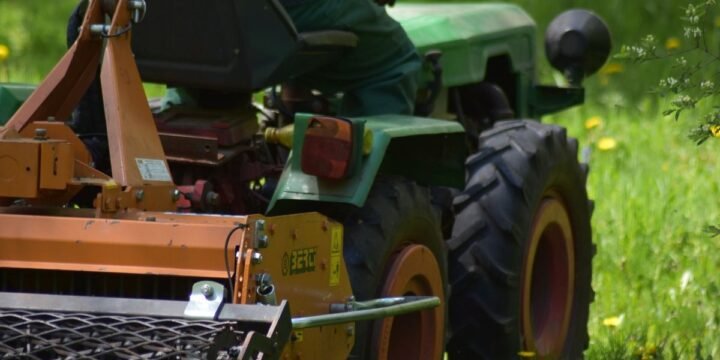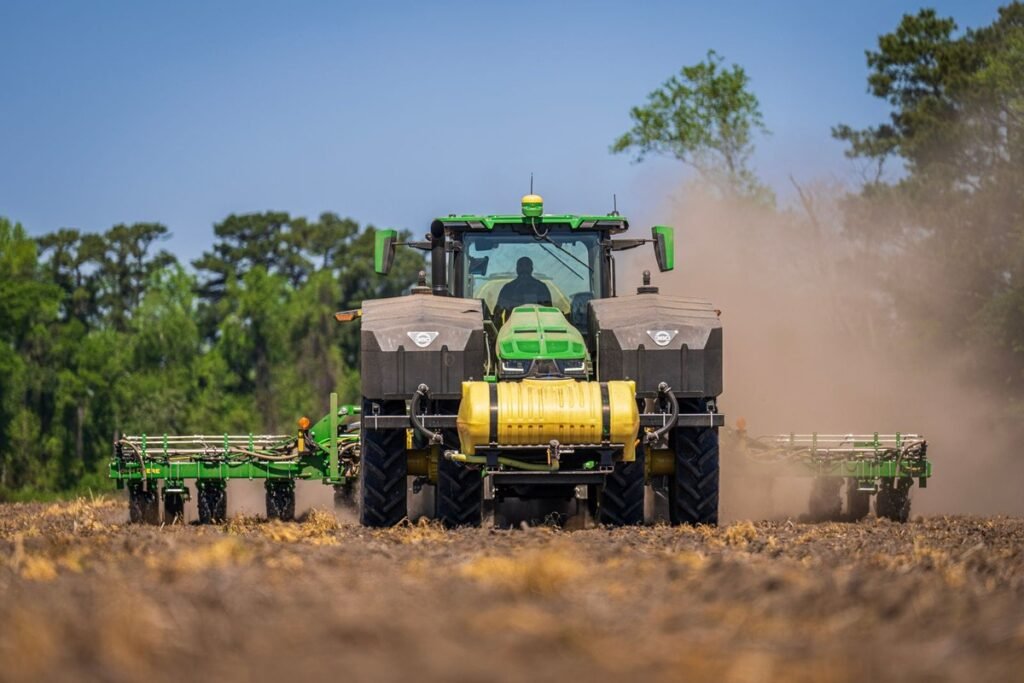
How many acres can a planter plant per hour? About 4 to 25 acres per hour. A 4 row planter covers about 4.24 acres per hour, a 12 row planter covers about 12.73 acres per hour, and a 24 row planter covers about 25.45 acres per hour, all at 5 mph and 70 percent efficiency with 30 inch row spacing.
In This Article
Row planter and grain drill rates are kept separate.
The Formula In Plain Words
Acres per hour equals width in ft times speed in mph times efficiency, divided by 8.25. Efficiency is written as a decimal, so 70 percent becomes 0.70 and 80 percent becomes 0.80. The constant 8.25 comes from 43560 divided by 5280, because an acre is 43560 square feet and a mile is 5280 feet. Use working width and average working speed, not top speed.
Take a rate of 2.45 acres per hour and a 20 acre field. Time is 20 divided by 2.45, which is 8.16 hours, so about 8.2 hours. Rounding that result to 8.1 hours would be wrong, and the error grows on a larger field. Keep two decimal places while you work, then round the final answer only.
How Many Acres Can a Planter Plant Per Hour by Rows
The table below uses 30 inch row spacing, so each row unit is 2.5 ft wide and width is row count times 2.5 ft. All rates use 5 mph and 70 percent efficiency, an average field, so you can compare sizes fairly. Time for 20 acres is 20 divided by the rate in the table.
| Planter size | Working width | Acres per hour | Time for 20 acres |
|---|---|---|---|
| 4 row | 10 ft | 4.24 | 4.72 hours |
| 6 row | 15 ft | 6.36 | 3.14 hours |
| 8 row | 20 ft | 8.48 | 2.36 hours |
| 12 row | 30 ft | 12.73 | 1.57 hours |
| 16 row | 40 ft | 16.97 | 1.18 hours |
| 24 row | 60 ft | 25.45 | 0.79 hours |
Check the 12 row line: 30 times 5 times 0.70 equals 105, divided by 8.25 equals 12.73 acres per hour.
The range lines up with the range given by Shuncy, which gives 10 to 30 acres per hour for a modern planter. That Shuncy range is that source figure, and it covers the middle and upper rows in the table.
The Per Row Unit Rule, Checked By Hand
NewAgTalk gives a handy rule: about 1 acre per row unit per hour in real world conditions at 5 mph and 70 percent efficiency. That NewAgTalk rule is that source figure, and it can be checked with the formula. One row unit at 30 inch spacing is 2.5 ft wide, and 2.5 times 5 times 0.70, divided by 8.25, equals 1.06 acres per hour per row unit. That matches the rule of about 1.
Multiply the row count by 1.06 to get the rate at 5 mph and 70 percent efficiency. A 6 row planter gives about 6.36 acres per hour, a 12 row planter gives about 12.72 acres per hour, and a 16 row planter gives about 16.96 acres per hour. The rule works only at that spacing, speed and efficiency.
How Speed And Efficiency Move The Rate
Take the 12 row planter at 30 ft wide. At 4 mph and 70 percent efficiency it covers 10.18 acres per hour: 30 times 4 times 0.70 equals 84, divided by 8.25 equals 10.18. At 5 mph it covers 12.73 acres per hour. At 6 mph it covers 15.27 acres per hour: 30 times 6 times 0.70 equals 126, divided by 8.25 equals 15.27. Each extra mile per hour adds about 2.55 acres per hour on this planter.
Efficiency moves the rate just as strongly. The verified bands are 55 to 65 percent for small or irregular fields, 70 to 75 percent for average fields, 80 to 85 percent for large rectangular fields, and 85 to 90 percent for ideal fields with GPS guidance. The same 12 row planter at 5 mph covers 10.00 acres per hour at 55 percent, 12.73 at 70 percent, 15.45 at 85 percent, and 16.36 at 90 percent.
A Full Worked Example: A 12 Row Planter On 100 Acres
Take a 100 acre field and a 12 row planter, 30 ft wide, at 5 mph and 70 percent efficiency. The rate is 12.73 acres per hour. Time is 100 divided by 12.73, which is 7.86 hours of planting time. That is planting time only, not the full day, because it does not include travel to the field or filling seed at the start.
Now change one input at a time. Raise efficiency to 85 percent and the rate becomes 15.45 acres per hour, so time for 100 acres falls to 6.47 hours, a saving of 1.39 hours. Drop speed to 4 mph instead, with efficiency back at 70 percent, and the rate becomes 10.18 acres per hour, so time rises to 9.82 hours, which adds 1.96 hours.
The Seed Refill Limit That Caps The Rate
A planter can only plant until its seed hoppers run out, and that limit caps the rate over a long day. Hours between refills equals seed in the hopper divided by seed used per hour, and seed used per hour equals seed per acre times acres per hour. A faster planter uses seed faster, so it needs refilling sooner, even though each refill covers the same number of acres.
Suppose one fill plants 40 acres. At 12.73 acres per hour, one fill lasts 3.14 hours: 40 divided by 12.73 equals 3.14. At 25.45 acres per hour, the same 40 acre fill lasts 1.57 hours: 40 divided by 25.45 equals 1.57. The larger planter refills about twice as often, because it covers ground about twice as fast.
Each refill also takes time, and that time lowers the effective rate for the day. Take the same example with assumed figures, labelled as an example and not as a specification for any named planter. Suppose each refill takes 20 minutes, which is 0.33 hours. Planting 40 acres takes 3.14 hours, plus 0.33 hours for the refill, which is 3.47 hours in total. The effective rate is 40 divided by 3.47, which is 11.53 acres per hour, not 12.73. Plan refills before you start, and count refill time in your efficiency figure or separately as shown above. The full planter and drill overview is at overview.
Row Planter Rates And Grain Drill Rates Kept Separate
A row planter and a grain drill are different machines, so their rates must not be mixed in one table. A row planter plants in wide rows, commonly 30 inch spacing, with one seed unit per row. A grain drill plants in narrow rows across its full width, and it is sold by width, not by row count. The formula is the same for both, but for a planter width comes from row count times row spacing, while for a drill width is the drill width itself.
The drill table below uses the same conditions as the planter table, 5 mph and 70 percent efficiency, so the two tables can be compared fairly. These are drill rates, labelled as drill rates, and they are not planter rates.
| Grain drill width | Acres per hour | Time for 20 acres |
|---|---|---|
| 10 ft | 4.24 | 4.72 hours |
| 15 ft | 6.36 | 3.14 hours |
| 20 ft | 8.48 | 2.36 hours |
| 30 ft | 12.73 | 1.57 hours |
A 15 ft drill and a 6 row planter both cover 6.36 acres per hour at these settings, because both work a 15 ft strip. That match is arithmetic, not a claim that the two machines do the same job. Use the planter table for row crops and the drill table for drilled crops.
The Same Answer In Metric Units
In metric units, use hectares per hour equals width in m times speed in km/h times efficiency, divided by 10. Take a 9 m planter at 8 km/h and 70 percent efficiency. The rate is 5.04 hectares per hour: 9 times 8 times 0.70 equals 50.4, divided by 10 equals 5.04.
Common Mistakes And Limitations
The most common mistake is using top speed instead of average working speed. Top speed gives a rate that looks strong and a time that looks short, and both are wrong for the real job. Time a real pass at normal planting pace and use that speed. The second mistake is using machine width instead of working width. On a planter, work out width from row count times row spacing, and subtract any strip left unplanted.
The third mistake is assuming 100 percent efficiency. No real planter works at 100 percent, because turns, headlands, refills and small stops always take time. Use the verified bands in this guide and pick the band that matches your field shape. The fourth mistake is forgetting the refill limit, and the fifth is mixing planter and drill rates. The sixth mistake is treating the table rate as exact, because the table uses stated settings, not a promise for your field. A related guide for a tractor is at guide.
Frequently Asked Questions
Q: How many acres can a planter plant per hour?
A: About 4 to 25 acres per hour in common field work. A 4 row planter covers about 4.24 acres per hour, a 12 row planter covers about 12.73 acres per hour, and a 24 row planter covers about 25.45 acres per hour, all at 5 mph and 70 percent efficiency.
Q: How many acres can a 12 row planter plant per hour?
A: About 12.73 acres per hour at 5 mph and 70 percent efficiency with 30 inch row spacing, because 30 ft times 5 times 0.70 divided by 8.25 equals 12.73.
Q: How many acres can a 6 row planter plant per hour?
A: About 6.36 acres per hour at 5 mph and 70 percent efficiency with 30 inch row spacing, because 15 ft times 5 times 0.70 divided by 8.25 equals 6.36.
Q: Does a bigger planter always finish faster?
A: Yes in acres per hour, because a wider planter covers a wider strip on each pass. It does not always finish a day faster by the same margin, because a bigger planter uses seed faster and needs refilling more often, and refill time lowers the effective rate.
Q: How do I work out the rate for my own planter?
A: Multiply your working width in ft by your average speed in mph and by your efficiency as a decimal, then divide by 8.25. For a planter, working width is row count times row spacing in ft. Test the result in the free acres per hour calculator on the homepage at calculator, then time a real pass to check it.
Plan Your Planting Day From Your Own Row Count
How many acres can a planter plant per hour comes down to three inputs and one limit. Width comes from row count and spacing, speed is your average working speed, efficiency comes from your field shape, and the seed refill limit caps the rate over a long day. Find your row count in the table, work your rate, count the refills, and test the plan in the free acres per hour calculator on the homepage at free calculator before you start.