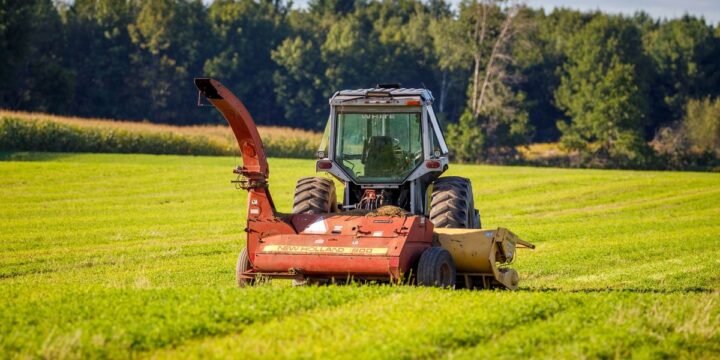
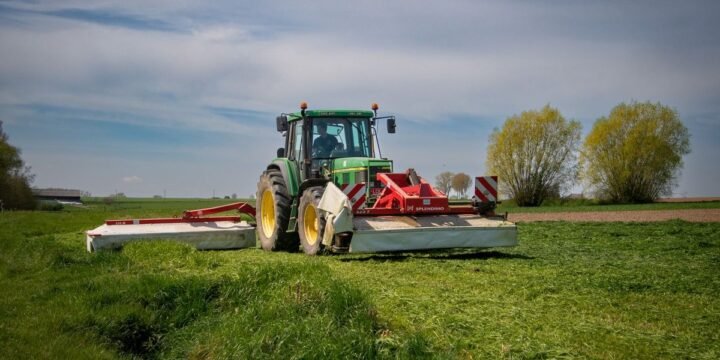
Bush hogging is rough cutting of tall grass, weeds, brush and saplings with a tractor mounted rotary cutter. It clears overgrown pasture, field edges and rough ground that a normal mower cannot handle. The cut is coarse and the finish is uneven, which is normal for this job. Bush hogging keeps land open, controls weeds and makes ground usable again.
Here, bush hogging means the job, and a bush hog means the rotary cutter. The cutter is pulled behind a tractor, and its heavy blades chop tall growth at ground level. It is built for rough ground, not for a neat lawn finish.
What a Bush Hog and Rotary Cutter Is
A bush hog is a rotary cutter. It is a wide deck with heavy blades that spin on a vertical shaft. The cutter connects to the tractor and is driven by the tractor power take off. The operator raises and lowers the deck to set the cutting height.
The blades are thick and blunt compared with the sharp blades on a finish mower. That blunt force lets the cutter chop stems and woody growth instead of slicing soft grass. The deck is built to take knocks from stones and stumps, although it is not proof against damage.
A wider cutter covers more ground in open land, but it is harder to move through gates and round trees. The tractor must have enough power to keep the blades at full speed in heavy growth.
What Land Bush Hogging Suits
Bush hogging suits pasture that has grown tall and coarse, field edges that have closed in, rough meadow and overgrown lots. It suits ground with tall grass, weeds, briars and light brush. It is the right first step when land has become too rough for a normal mower.
Bush hogging does not suit a lawn, a garden or any place where a smooth finish matters. It does not suit ground with hidden wire, rubble or large stumps, because those hazards can damage the cutter and throw debris. It does not suit very steep ground unless the tractor and cutter are safe for that slope.
Bush Hogging Compared With Finish Mowing
Bush hogging and finish mowing look similar, but they do different jobs. Finish mowing is for lawns and tidy grass, where the aim is a smooth surface. Bush hogging is for rough ground, where the aim is to cut growth down and keep land open.
| Feature | Bush Hogging | Finish Mowing |
|---|---|---|
| Main purpose | Clear rough growth and keep land open | Keep lawns and tidy grass neat |
| Growth handled | Tall grass weeds brush and light saplings | Short soft lawn grass |
| Cut quality | Coarse and uneven | Smooth and even |
| Ground suited | Rough uneven and overgrown land | Flat even and clear lawns |
| Machine used | Tractor mounted rotary cutter | Lawn mower or finish mower |
| Speed of work | Slower in thick growth | Faster on clear lawns |
A finish mower will struggle in tall brush, while a bush hog will leave a lawn looking torn. Use each machine for the job it was built for. If the land is rough, start with bush hogging.
How Fast Bush Hogging Goes
Speed is measured in acres per hour. The rate depends on working width, average speed and field efficiency. Working width is the actual cut swath minus overlap, not machine width. Speed is average speed held safely, not top speed.
Acres per hour equals width in ft times speed in mph times efficiency divided by 8.25. Use the Acres Per Hour Calculator to try your own width, speed and efficiency. Use the how to calculate acres per hour guide for the full method.
Worked Example
Take a 6 ft cutter at 4.5 mph and 75 percent efficiency. First multiply width by speed. Then multiply by efficiency. Then divide by 8.25. 6 times 4.5 equals 27. 27 times 0.75 equals 20.25. 20.25 divided by 8.25 equals 2.45 acres per hour.
A 20 acre pasture at that rate takes about 8.2 hours. That time is cutting time in the field. It does not include travel, fuel stops, or time spent clearing debris. Allow more time if the growth is heavy or the field is awkward.
Use the bush hog acres per hour calculator to repeat this check for your own cutter width and terrain. It lets you compare widths and terrain settings before you start.
Field Efficiency Bands
Efficiency is where many estimates go wrong. A high figure looks good on paper but it is only right for large and simple fields. Use a lower figure for small or awkward ground. The bands below are the bands published on the site.
| Field Type | Efficiency |
|---|---|
| Small or irregular fields | 55 to 65 percent |
| Average fields | 70 to 75 percent |
| Large rectangular fields | 80 to 85 percent |
| Ideal fields with GPS guidance | 88 to 90 percent |
For most pasture work, the average band is the safe starting point. Move to a higher band only when the field is large, rectangular and clear. Move to a lower band when the field is small, irregular, wet or full of obstacles. Read more in the bush hog rotary cutter productivity guide.
What Affects How Fast It Goes
Vegetation and terrain set the pace. Light regrowth cuts fast because the blades can hold full speed. Tall and tangled growth cuts slowly because the blades have more material to chop. Flat open ground lets the operator hold a steady speed, while slopes, ditches and wet patches force slower passes.
Obstacles and field shape also matter. Trees, rocks, stumps and debris force the operator to slow down or steer round the hazard. Long straight passes are fast because turning is rare. Short passes are slow because turning takes a large share of the time.
Field Checks Before You Start
Walk the field first. Mark stumps, rocks, holes and wire hidden in tall grass, and check that the cutter can pass through gates and turn inside the field. Check tyres, blades, guards and the power take off shaft, and plan long straight passes with a small overlap.
Safety Basics
Bush hogging throws debris, so keep people and animals well clear. Never let anyone walk beside the cutter while it is running. Stay in the seat, keep hands and feet clear of moving parts, and wait for the blades to stop before you inspect the cutter. Work within safe limits for slopes, and wear eye and hearing protection with sturdy boots.
Common Mistakes and Limitations
The most common mistake is to use machine width instead of working width. Measure the actual cut swath minus overlap and use that figure in the formula. Using the wrong width makes the estimate too high and the job takes longer than planned.
The second mistake is to use top speed instead of average speed held safely, and to assume high efficiency for a difficult field. Bush hogging will not remove large stumps or level ground, and it will not give a lawn finish. Cut before seed heads mature when you can, and plan a follow up pass if regrowth is fast.
Hire It Done or Do It Yourself
Doing it yourself makes sense when you own a suitable tractor and cutter, you know the land, and the area is small enough to finish in the time you have. Keep a record of the time each field takes, so your next estimate is based on real work.
Hiring a contractor makes sense when the land is large, the growth is heavy, or you do not have the right machine. Ask the contractor to walk the field before quoting, and put the terms in writing so both sides know what to expect.
Cost Context
This guide does not set prices, because prices vary with land, travel, machine size and local conditions. For cost planning, use the live tools on this site. The bush hogging cost calculator works out total hours, job price and cost per acre from area, cutter width, terrain and your hourly rate. The bush hogging cost per acre guide explains how cost per acre is worked out from time. People also search for the same idea as cost to bush hog per acre and bush hog cost per acre.
The live cost calculator uses an $85 per hour figure labelled on that page as an example rate only. That figure is not presented here as a market rate. Enter your own hourly rate in the calculator.
Frequently Asked Questions
Q: What is bush hogging?
A: Bush hogging is rough cutting of tall grass, weeds, brush and light saplings with a tractor mounted rotary cutter. It clears overgrown pasture and keeps land open and usable.
Q: Is bush hogging the same as mowing?
A: No. Finish mowing is for lawns and leaves a smooth finish. Bush hogging is for rough land and leaves a coarse finish. Each job needs its own machine.
Q: How long does it take to bush hog a pasture?
A: It depends on cutter width, speed and field efficiency. As a worked example, a 6 ft cutter at 4.5 mph and 75 percent efficiency covers 2.45 acres per hour, so a 20 acre pasture takes about 8.2 hours of cutting time.
Q: Can bush hogging clear saplings and brush?
A: It can clear light saplings and brush within the safe working limits of the cutter. It cannot clear large trees or heavy woodland, and woody stems thicker than the cutter is rated for will slow the work.
Q: When is the best time to bush hog?
A: Cut when the ground is firm enough to carry the tractor without rutting and before seed heads mature where you can. Avoid wet ground, poor light and unsafe slopes.
Q: Should I hire bush hogging or do it myself?
A: Do it yourself when you have the right tractor and cutter and the land is familiar. Hire a contractor when the land is large, heavy, steep or full of hazards.
Bush hogging is a practical way to take rough land back into use. Walk the field, choose a realistic rate, work safely and plan the time with care.