How many acres can a field cultivator cover per hour? A 24 foot field cultivator covers about 14.84 acres per hour at 6 miles per hour and 85 percent efficiency. A 12 foot cultivator covers about 7.42 acres per hour at the same speed and efficiency, and a 30 foot cultivator covers about 18.55 acres per hour.
A field cultivator is the fastest common tillage tool in the verified table for a large field. It works a wide strip at a steady speed and prepares a seedbed in one pass. This guide sets out the rate by width, by speed, and by efficiency.
Table of Contents
What a Field Cultivator Does
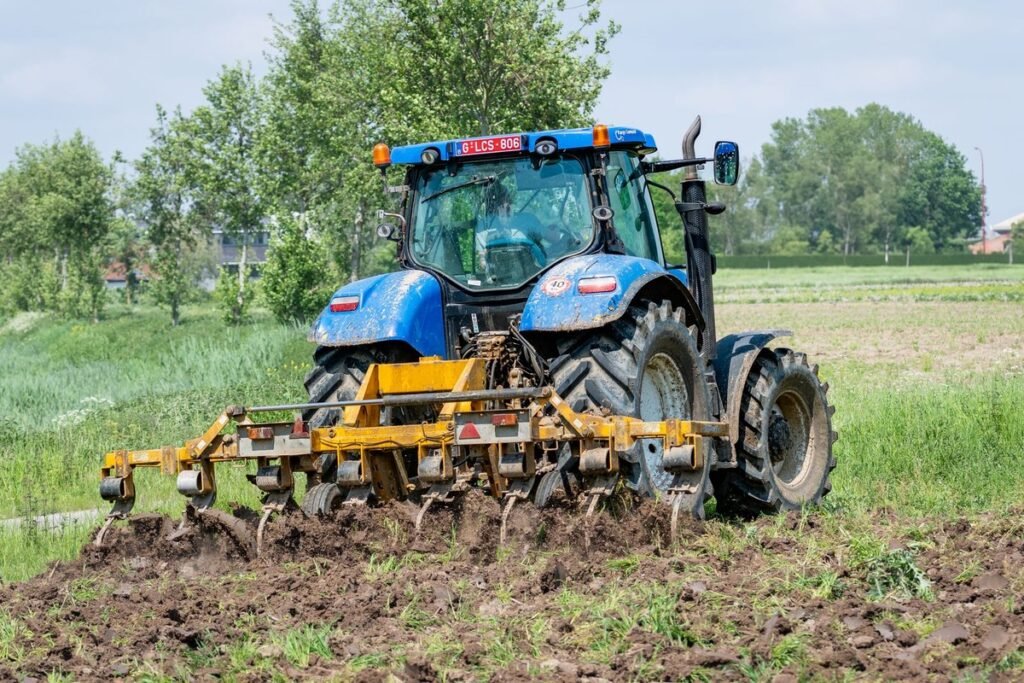
A field cultivator uses spring shanks with sweeps or points to lift, mix, and level soil. It breaks clods, mixes residue, and leaves a level seedbed for planting. It is a secondary tillage tool in most plans, used after a plow, a chisel plow, or a disc harrow.
A field cultivator is not a plow and it is not a rotary tiller. A plow turns soil over in a deep pass. A rotary tiller chops soil slowly with spinning tines. A field cultivator works a wide strip at a steady speed, so it covers ground fast. The tillage equipment productivity guide gives the wider tillage picture.
The Formula for a Field Cultivator
To get acres per hour, multiply width in feet by speed in miles per hour and by efficiency, then divide by 8.25. 8.25 comes from 43560 divided by 5280, the square feet in an acre divided by the feet in a mile. Efficiency is written as a decimal, so 85 percent is 0.85 and 75 percent is 0.75.
Take the 24 foot field cultivator from the verified table. Width times speed is 24 times 6, which equals 144. Multiply by efficiency as a decimal. 144 times 0.85 equals 122.4. Divide by 8.25. 122.4 divided by 8.25 equals 14.84 acres per hour after rounding. Time is acres divided by acres per hour. The whole number gives hours, and the part after the decimal point times 60 gives minutes. Times in this guide use the unrounded rate throughout, so dividing acres by the rounded rate in the text gives a slightly different time.
How Many Acres by Field Cultivator Width
The table below fixes speed and efficiency, so only width changes. Every row uses 6 miles per hour and 85 percent efficiency. A wider cultivator covers more acres per hour, and minutes per acre fall as width rises.
| Field cultivator width | Acres per hour | Minutes per acre | Hours for 100 acres |
|---|---|---|---|
| 12 ft | 7.42 | 8.1 | 13.48 |
| 18 ft | 11.13 | 5.4 | 8.99 |
| 24 ft | 14.84 | 4.0 | 6.74 |
| 30 ft | 18.55 | 3.2 | 5.39 |
Read the table from your cultivator width. A 12 foot cultivator covers 7.42 acres per hour, and a 30 foot cultivator covers 18.55. The step from 12 foot to 30 foot saves 8.09 hours on 100 acres. That saving holds only when the wider cultivator can keep the same speed and efficiency on your soil. A cultivator too wide for the tractor will slow down in heavy soil, and the rate falls with it.
How Speed Changes a Field Cultivator Rate
Speed weighs the same as width in the formula, so a faster pass covers more acres per hour in direct proportion. The table below keeps a 24 foot cultivator at 85 percent efficiency fixed and changes speed only.
| Speed in miles per hour | Acres per hour | Minutes per acre |
|---|---|---|
| 5 | 12.36 | 4.9 |
| 6 | 14.84 | 4.0 |
| 7 | 17.31 | 3.5 |
| 8 | 19.78 | 3.0 |
Moving from 5 to 8 miles per hour lifts the rate by 7.42 acres per hour. That gain holds only when the higher speed still leaves a level seedbed. Too fast, and the shanks can leave an uneven surface or throw soil. Use the speed where the seedbed stays level across the full width, not the fastest speed the tractor can reach.
How Efficiency Changes a Field Cultivator Rate
Efficiency is the input most people guess, and it is the input that most often explains a real job that takes longer than the plan. The table below keeps a 24 foot cultivator at 6 miles per hour fixed and changes efficiency only.
| Efficiency | Acres per hour | Minutes per acre |
|---|---|---|
| 75 percent | 13.09 | 4.6 |
| 80 percent | 13.96 | 4.3 |
| 85 percent | 14.84 | 4.0 |
| 90 percent | 15.71 | 3.8 |
The gap between 75 percent and 90 percent is 2.62 acres per hour. Use 85 percent as a planning start for a large open field, because that is the rate in the verified table. Go down for a smaller or irregular field with many turns, and up to 90 percent only for an ideal large rectangular field with long straight passes. If you are unsure, pick the lower efficiency. The guide on understanding field efficiency shows how turns and overlap build the efficiency figure.
How Many Acres Can a Field Cultivator Cover Per Hour
Use the 24 foot rate of 14.84 acres per hour to plan common jobs. Twenty acres takes 20 divided by 14.84, which equals 1.35 hours, or about 1 hour and 21 minutes. Fifty five acres takes 3.71 hours from the unrounded rate, or about 3 hours and 42 minutes. One hundred acres takes 100 divided by 14.84, which equals 6.74 hours, or about 6 hours and 44 minutes. Two hundred acres takes 200 divided by 14.84, which equals 13.48 hours.
The 55 acre time is the second question this guide answers. A large field cultivator finishes 55 acres in under 4 hours, while a small moldboard plow would need many days for the same acres. Run your own numbers through the Tilling Acres Per Hour Calculator before you book a day for a large cultivator job.
Small Tractor and Large Tractor Rates, Kept Separate
Small tractor and large tractor field cultivator rates are different, and they should not be mixed in one row. A small tractor setup in this guide is a 6 foot cultivator at 3.5 miles per hour and 70 percent efficiency, giving 1.78 acres per hour. That rate comes from the Phase 2 general table, and it is restated here only to label the small setup, with its inputs stated beside it. A large tractor setup is a 24 foot cultivator at 6 miles per hour and 85 percent efficiency, giving 14.84 acres per hour.
The gap is wide. The large setup covers in about 7 minutes what the small setup covers in about 1 hour, because 14.84 divided by 1.78 equals about 8.3, and 60 divided by 8.3 equals about 7.2 minutes. Do not use a large cultivator rate for a small tractor, and do not use a small rate for a large tractor. Pick the row that matches your tractor and your cultivator width.
Two More Cultivator Rates at Stated Inputs
Two more worked rates show why inputs matter, using only the formula in this guide. A 36 foot field cultivator at 6 miles per hour and 85 percent efficiency covers 22.25 acres per hour, because 36 times 6 times 0.85 equals 183.6, and 183.6 divided by 8.25 equals 22.25. At 80 percent efficiency, the same width and speed give 20.95 acres per hour. The five points of efficiency are worth about 1.30 acres per hour at that width.
A 15 foot field cultivator at 5.5 miles per hour and 80 percent efficiency covers 8.00 acres per hour, because 15 times 5.5 times 0.80 equals 66, and 66 divided by 8.25 equals 8.00. At 85 percent efficiency, the same width and speed give 8.50 acres per hour. The difference between the two figures is efficiency alone, not a different formula, so always read the efficiency beside a rate before you use it.
What Changes Your Field Cultivator Rate
Shank load sets the pace on a field cultivator. Spring shanks that trip and reset in hard ground break the rhythm of the pass, and the tractor must slow until the shanks stay at depth. Wet ground makes the shanks smear the soil instead of lifting it, and dry ground that has set hard can force a shallow first pass.
Field layout sets the efficiency after that. Long straight runs keep the sweeps working most of the hour, while short runs with many turns spend much of the hour turning. A cultivator wider than the tractor can pull will slow in heavy ground. A shallow pass that runs fast is no saving if it leaves the seedbed uneven and the ground needs another pass.
Common Mistakes and Limitations
The first error is planning from width and speed with efficiency left at 100 percent. That figure is the fastest rate the cultivator could ever reach, not the rate it will reach in a real field. The second error is planning from the fastest speed the tractor can reach. Plan from the speed where the seedbed stays level, because a rushed pass leaves an uneven surface. The third error is using a wide cultivator rate for a narrow cultivator. Match the rate to the cultivator in front of you.
The fourth error is running too fast and leaving an uneven seedbed, then treating the second pass as free. It doubles the time on that ground, so a steady pass at a level finish is usually the faster day. The fifth error is forgetting travel, hitching and breaks, which are real hours outside acres per hour. Treat the result as a planning figure, then check it against a timed field.
Frequently Asked Questions
Q: How many acres can a field cultivator cover per hour?
A: A 24 foot field cultivator covers about 14.84 acres per hour at 6 miles per hour and 85 percent efficiency. A 12 foot cultivator covers about 7.42, and a 30 foot cultivator covers about 18.55.
Q: How do I work out acres per hour for a field cultivator?
A: Work out width in feet times speed in miles per hour times efficiency as a decimal, then divide by 8.25. For a 24 foot cultivator at 6 miles per hour and 85 percent efficiency, that is 24 times 6 times 0.85 divided by 8.25, which equals 14.84.
Q: How long does it take a field cultivator to cover 100 acres?
A: With a 24 foot cultivator at 6 miles per hour and 85 percent efficiency, 100 acres takes 6.74 hours, or about 6 hours and 44 minutes. With a 12 foot cultivator it takes about 13.48 hours.
Q: How long does it take a field cultivator to cover 55 acres?
A: At 14.84 acres per hour, 55 acres takes about 3.71 hours. That is under 4 hours for a large field cultivator on a fairly open field.
Q: Is a field cultivator faster than a disc harrow?
A: Yes, at the verified rates. A 24 foot field cultivator covers 14.84 acres per hour, while a 14 foot disc harrow covers 6.79 acres per hour. Width and speed explain most of that gap.
Q: Can I just go faster with a field cultivator?
A: No, not beyond the speed where the seedbed stays level. Too fast, and the shanks can leave an uneven surface, which often needs a second pass.
Plan From Your Field Cultivator Width, Speed, and Efficiency
A field cultivator rate is not one fixed number. It is a result from cultivator width, ground speed and efficiency for one setup in one field. Find your cultivator width, hold a speed where the seedbed stays level, and pick an efficiency that matches the field. Work out the time from the rate, and add travel and breaks on top. Run your own numbers through the Tilling Acres Per Hour Calculator before the next field cultivator job.