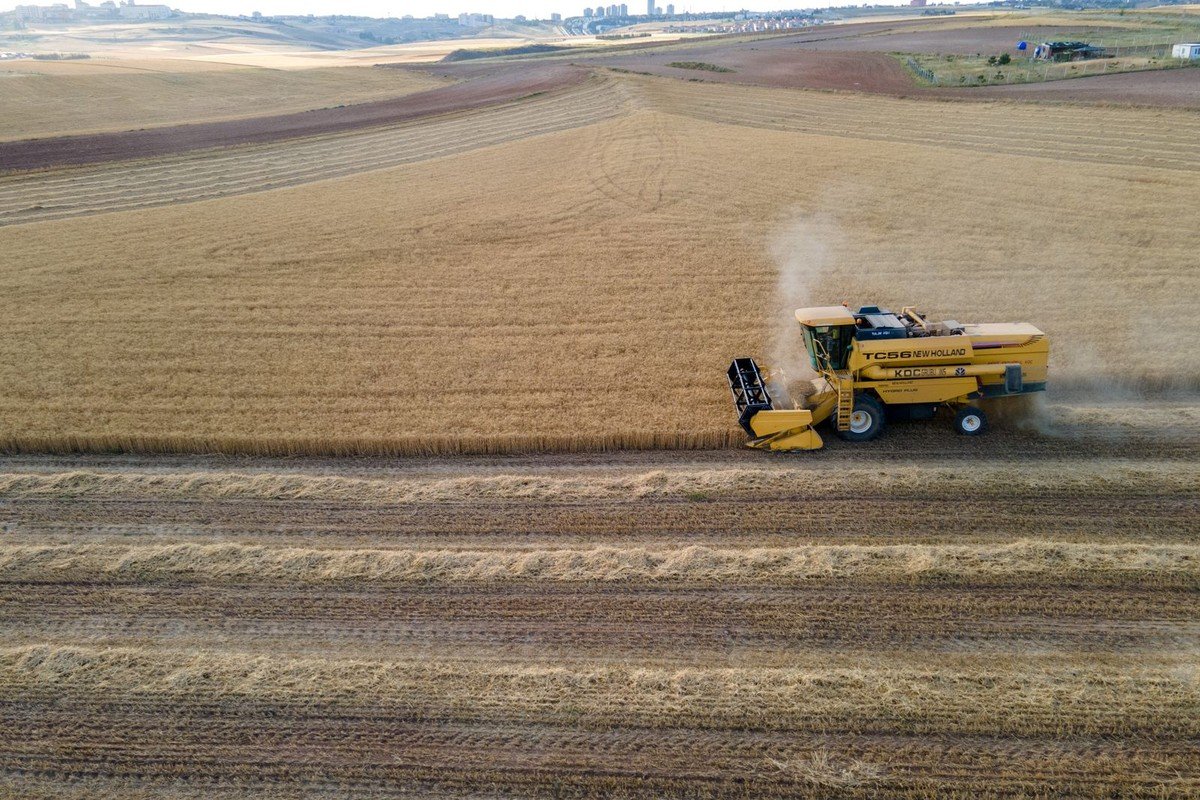
How long to harvest 160 acres with a combine depends on header width, speed and efficiency. With a 30 ft header at 4.5 mph and 75 percent efficiency, the rate is 12.27 acres per hour, so 160 acres takes about 13 hours. Wider headers cut that time, while narrow headers stretch it past a day of field work.
How Long to Harvest 160 Acres With a Combine at Each Header Width
The table below gives the time for 160 acres at every verified combine rate. Each time comes from dividing 160 acres by the unrounded rate for that row. A wider header in this table also runs a little faster and at a little higher efficiency, as larger combines normally do. Read the time beside the header width you run.
| Header | Speed | Efficiency | Acres per hour | Time for 160 acres |
|---|---|---|---|---|
| 15 ft | 4 mph | 75 percent | 5.45 | About 29.3 hours |
| 20 ft | 4.5 mph | 75 percent | 8.18 | About 19.6 hours |
| 25 ft | 4.5 mph | 75 percent | 10.23 | About 15.6 hours |
| 30 ft | 4.5 mph | 75 percent | 12.27 | About 13.0 hours |
| 35 ft | 5 mph | 80 percent | 16.97 | About 9.4 hours |
| 40 ft | 5 mph | 80 percent | 19.39 | About 8.3 hours |
| 45 ft | 5.5 mph | 80 percent | 24.00 | About 6.7 hours |
A 15 ft header takes about 29.3 hours for 160 acres, while a 45 ft header takes about 6.7 hours for the same 160 acres. The difference is about 22.67 hours, worked out from the unrounded rates. The widest header covers about 4.4 times as much ground per hour as the narrowest header, because 24.00 divided by 5.45 is about 4.4.
The middle rows show the same pattern in smaller steps. Moving from a 20 ft header to a 25 ft header cuts the time from about 19.6 hours to about 15.6 hours. Moving from a 30 ft header to a 35 ft header cuts the time from about 13.0 hours to about 9.4 hours. Use the row that matches your machine, and plan from that row.
All times in this table are field work time only. They count time spent cutting new ground at the stated rate, with turns, unloading and short stops already allowed for inside the efficiency figure. They do not count travel, refuelling, meals or breaks. Add those items separately.
The Formula Behind the 160 Acre Time
Acres per hour equals header width in ft times speed in mph times efficiency divided by 8.25. Efficiency is written as a decimal, so 75 percent becomes 0.75 and 80 percent becomes 0.80. Header width is the working width that actually cuts crop on each pass. Speed is the average ground speed held while cutting. Efficiency is the share of time spent cutting new ground at full width, after allowing for turns, unloading, adjustments and stops.
The headline worked example uses a 30 ft header at 4.5 mph and 75 percent efficiency. First multiply width by speed, so 30 times 4.5 equals 135. Then multiply by efficiency as a decimal, so 135 times 0.75 equals 101.25. Then divide by 8.25, so 101.25 divided by 8.25 equals 12.272727 acres per hour, shown as 12.27 acres per hour.
Time for a field equals field size in acres divided by acres per hour. For the headline field, 160 divided by 12.272727 equals 13.037037 hours, shown as 13.04 hours, or about 13 hours. The calculation uses the unrounded rate, and the final value is rounded only at the end.
The same method works for any field size, once you have the rate. An 80 acre field at 12.272727 acres per hour takes 80 divided by 12.272727, which equals 6.52 hours. A 320 acre field at the same rate takes 320 divided by 12.272727, which equals 26.07 hours. Double the acres, and the time doubles. Use the harvesting acres per hour calculator to run your own numbers, and read the how to calculate acres per hour guide for the full method.
Bushels per hour is a separate number, and it does not change the time for 160 acres. Bushels per hour equals acres per hour times yield in bushels per acre. At the verified yield of 180 bushels per acre, the headline rate moves 12.272727 times 180, which equals about 2209 bushels per hour. Grain carts and trucks must be planned from bushels per hour, not from acres per hour alone.
What Efficiency Does to the 160 Acre Time
Efficiency is the number that most harvest plans get wrong, because it is easy to pick a high figure that looks good on paper and hard to hold it in the field. The site bands are 55 to 65 percent for small or irregular fields, 70 to 75 percent for average fields, 80 to 85 percent for large rectangular fields, and 85 to 90 percent for ideal fields with GPS guidance. The ideal band is 85 to 90 percent, never 88 to 90 percent. Pick the band that matches the field in front of you.
The table below shows what efficiency does to the time for 160 acres with one header held fixed, a 30 ft header at 4.5 mph. Only efficiency changes from row to row, so the change in time comes from efficiency alone.
| Efficiency | Acres per hour | Time for 160 acres |
|---|---|---|
| 65 percent | 10.64 | About 15.0 hours |
| 75 percent | 12.27 | About 13.0 hours |
| 80 percent | 13.09 | About 12.2 hours |
| 85 percent | 13.91 | About 11.5 hours |
| 90 percent | 14.73 | About 10.9 hours |
At 65 percent efficiency, the 30 ft header covers 10.64 acres per hour, and 160 acres takes about 15.0 hours. At 75 percent, the same header covers 12.27 acres per hour, and the time is about 13.0 hours. At 90 percent, the rate rises to 14.73 acres per hour, and the time falls to about 10.9 hours. The full span from 65 percent to 90 percent is about 4.2 hours, worked out from the unrounded rates.
That span is the reason to measure efficiency from your own fields. If you plan at 85 percent and the field only allows 65 percent, the harvest takes about 3.5 hours longer than the plan, because 15.04 hours minus 11.50 hours equals 3.54 hours. Start with the average band for an ordinary field, then adjust from a record of acres and hours for fields you have already cut.
How Unloading and Crop Condition Change the Time
Unloading on the go with a grain cart can add several points of efficiency. That is the guidance on the live calculator page, and it is the simplest way to lift the real rate without raising speed. When the combine unloads on the go, it keeps cutting while the cart takes the grain. When the combine stops at the field edge to unload, the cutting stops for every load, and those minutes add up across 160 acres.
Grain handling must keep up with the combine, or the efficiency gain from unloading on the go is lost. If the cart is late, the combine waits, and waiting time lowers efficiency for the whole field. Plan the cart and truck cycle from bushels per hour, because that is the flow the carts and trucks must clear. At the headline rate, that flow is about 2209 bushels per hour at 180 bushels per acre.
In high yielding crops the threshing system, not the header, often limits speed. The header can gather crop faster than the threshing system can process it, and the first sign is rising grain loss behind the combine. When losses rise, slow down. Lodged, tough or weedy crops demand slower speeds to limit losses, and the time for 160 acres rises. Pick a speed you can hold while losses stay low, and plan the time from that rate. The combine harvester productivity guide gives the same limits for larger fields, with time for 400, 800 and 1200 acre fields.
How to Plan a 160 Acre Harvest From the Rate
Start with the rate, then work out the time, then add the items that sit outside the time. First, write down your header width in ft, your average speed in mph while cutting, and your efficiency as a decimal. Second, multiply width by speed, multiply by efficiency, and divide by 8.25 to get acres per hour. Third, divide 160 by that rate to get field work time in hours. Fourth, add travel, refuelling, meals and breaks separately, because none of those items is inside the field work time.
Check the plan against the table before you trust it. If your rate is close to a row in the table, your time should be close to the time in that row. The most common error is to use the full header width instead of the working width, so the rate comes out too high and the time comes out too short. The next error is to use top speed instead of average speed while cutting. The third error is to use 100 percent efficiency, which assumes the combine never turns, never unloads and never stops. Keep a simple record for each field, so the next plan starts from real numbers.
Frequently Asked Questions
Q: How long does it take to harvest 160 acres with a combine?
A: About 13 hours of field work time with a 30 ft header at 4.5 mph and 75 percent efficiency, because the rate is 12.27 acres per hour and 160 divided by 12.272727 equals 13.04 hours. Travel, refuelling, meals and breaks sit outside that time.
Q: How long does it take to harvest 160 acres with a 40 ft header?
A: About 8.3 hours of field work time, because a 40 ft header at 5 mph and 80 percent efficiency covers 19.39 acres per hour, and 160 divided by 19.393939 equals 8.25 hours.
Q: How long does it take to harvest 160 acres with a 20 ft header?
A: About 19.6 hours of field work time, because a 20 ft header at 4.5 mph and 75 percent efficiency covers 8.18 acres per hour, and 160 divided by 8.181818 equals 19.56 hours.
Q: How do I calculate harvest time for 160 acres?
A: Work out acres per hour first, then divide 160 by that rate. Acres per hour equals header width in ft times speed in mph times efficiency divided by 8.25. For a 30 ft header at 4.5 mph and 75 percent efficiency, that is 12.27 acres per hour, and 160 divided by 12.272727 equals 13.04 hours.
Q: Does unloading time count in the 13 hour figure?
A: Stopping to unload is already allowed for inside the efficiency figure, while travel, refuelling, meals and breaks sit outside the time. Unloading on the go with a grain cart can add several points of efficiency.
Q: Why do two combines give different times for the same 160 acres?
A: Because header width, speed and efficiency differ. The same 160 acres takes 13.04 hours at 12.27 acres per hour, from a 30 ft header at 4.5 mph and 75 percent efficiency, and 17.96 hours at 8.91 acres per hour, from the same 30 ft header at 3.5 mph and 70 percent efficiency.
Plan From the Rate for Your Field
How long to harvest 160 acres with a combine is answered by the rate, and the rate is answered by header width, speed and efficiency. With a 30 ft header at 4.5 mph and 75 percent efficiency, the answer is about 13 hours of field work time. With a wider header, the answer falls to about 6.7 hours at 45 ft. With a narrower header, the answer rises to about 29.3 hours at 15 ft. Work out your own rate, divide 160 by that rate, and add travel and breaks separately.