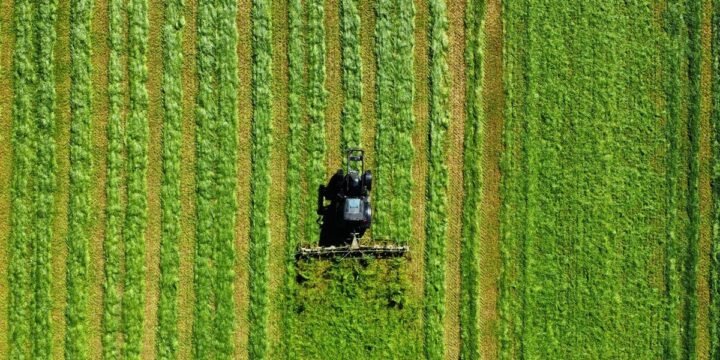
Guidance systems, from simple lightbars to auto steer, help operators drive straight, parallel passes, and that is the heart of GPS guidance and field efficiency. The main productivity gain comes from reducing overlap: a 40 ft implement with 2 ft of overlap cuts 38 ft of new ground per pass, but with guidance cutting overlap to 0.5 ft it cuts 39.5 ft, and the rate rises from 22.11 to 22.98 acres per hour at 6 mph and 80 percent efficiency.
That gain looks small on one pass, but it repeats on every pass of every field, all season. Less overlap also means less seed, fertilizer, chemical and fuel used per acre, and fewer skips that need fixing later.
Table of Contents
GPS Guidance and Field Efficiency: Overlap Reduces Effective Width
Effective width equals implement width minus average overlap. A 40 ft implement driven with an average 2 ft overlap has an effective width of 38 ft, a 5 percent loss. If guidance reduces overlap to 0.5 ft, the effective width becomes 39.5 ft. At 6 mph and 80 percent, that raises the rate from 22.11 to 22.98 acres per hour.
Check the maths. Without guidance: 38 times 6 times 0.80 divided by 8.25 is 22.11 acres per hour. With guidance: 39.5 times 6 times 0.80 divided by 8.25 is 22.98 acres per hour. The gain is 0.87 acres per hour, which is about 4 percent. Use the how to calculate acres per hour guide for the full method, and enter the effective width, not the implement width, in the calculator.
Overlap is easy to underestimate in GPS guidance and field efficiency because it is hard to see from the cab. On a wide implement the far edge is a long way from the driver, so the driver overlaps by more than they think to avoid a skip. In low light or dust the overlap grows further.
Overlap Gain by Implement Width
| Implement | Width | Overlap before | Effective width | Rate before | Overlap after | Effective width | Rate after |
|---|---|---|---|---|---|---|---|
| Planter | 20 ft | 1 ft | 19 ft | 8.64 | 0.25 ft | 19.75 ft | 8.98 |
| Sprayer | 60 ft | 3 ft | 57 ft | 33.16 | 0.5 ft | 59.5 ft | 34.62 |
| Tillage tool | 40 ft | 2 ft | 38 ft | 22.11 | 0.5 ft | 39.5 ft | 22.98 |
The planter row runs at 5 mph and 75 percent efficiency: 19 times 5 times 0.75 divided by 8.25 is 8.64 acres per hour, and 19.75 times 5 times 0.75 divided by 8.25 is 8.98 acres per hour. The sprayer row runs at 6 mph and 80 percent efficiency: 57 times 6 times 0.80 divided by 8.25 is 33.16 acres per hour, and 59.5 times 6 times 0.80 divided by 8.25 is 34.62 acres per hour.
Read the table for the pattern of GPS guidance and field efficiency. The gain in acres per hour grows with implement width. The sprayer gains 1.46 acres per hour from the same kind of overlap cut that gains the planter only 0.34 acres per hour. That is why guidance pays back fastest on wide implements.
The gain from GPS guidance and field efficiency also grows with the overlap you start from. A driver who already overlaps by only 1 ft on a 40 ft tool has less to gain than a driver who overlaps by 3 ft. Measure your own overlap before you buy, so the payback figure is based on your fields.
Overlap as a Share of Width
| Implement width | 1 ft overlap | 2 ft overlap |
|---|---|---|
| 20 ft | 5.0 percent | 10 percent |
| 40 ft | 2.5 percent | 5 percent |
| 60 ft | 1.7 percent | 3.3 percent |
| 90 ft | 1.1 percent | 2.2 percent |
The table shows that a fixed overlap hurts narrow implements more than wide ones in percentage terms. One foot of overlap on a 20 ft planter is 5 percent of the width, while one foot on a 90 ft boom is only 1.1 percent. But the absolute loss matters too: 2 ft of overlap on a 90 ft boom is still 2 ft of ground covered twice on every pass.
Skips are the other side of overlap. When a driver tries to avoid overlap by steering wide, gaps appear between passes. A skip in planting leaves a bare strip. A skip in spraying leaves weeds standing. Guidance cuts both errors at once: it holds the pass line so the driver neither overlaps nor leaves a gap.
Where Guidance Helps Most
Wide implements gain the most, because it is hard to judge the edge of a 90 ft boom by eye, so overlap tends to be larger. Operations with no visible marks gain the most too. Spreading, spraying and pre plant tillage leave few clues to follow, so the driver has nothing to steer by except memory and guesswork. Guidance gives that driver a line to follow.
Long days and low light are the third case. Guidance reduces operator fatigue and allows accurate work at dusk, when the light is flat and the last pass is hard to see.
Small and irregular fields gain less from GPS guidance and field efficiency on overlap alone, because turning takes a larger share of the time there. But guidance still helps by keeping passes straight and cutting skips on headlands and point rows. Use the field shape and productivity guide to see how field shape changes the efficiency band for your ground.
Field Efficiency Bands
Efficiency is the share of time spent cutting new ground, and GPS guidance and field efficiency raises it by cutting overlap and skips. The bands below are the bands published on this site. Use them as a starting point, then measure your own rate in the field.
| Field type | Efficiency |
|---|---|
| Small or irregular fields | 55 to 65 percent |
| Average fields | 70 to 75 percent |
| Large rectangular fields | 80 to 85 percent |
| Ideal fields with GPS guidance | 85 to 90 percent |
For most field work, the average band is the safe starting point. Move to a higher band only when the field is large, rectangular and clear. Move to a lower band when the field is small, irregular, wet or full of obstacles. The ideal band of 85 to 90 percent applies to large, simple fields where guidance holds the pass line and turns are few. It does not apply to a small field with short passes, even with the best guidance system.
Do not use the ideal band to plan a job on average ground. A rate worked out at 90 percent efficiency on a field that really runs at 70 percent will be nearly 30 percent too high.
Other Benefits
Less overlap also means less seed, fertilizer, chemical and fuel used per acre, because every overlapped strip is ground that gets a double dose. Over a season, a 5 percent overlap is 5 percent more seed and chemical than the crop needs.
Section control on sprayers and planters adds savings on headlands and point rows, where sections shut off automatically instead of double covering ground already passed.
GPS guidance and field efficiency also leaves a record of where the machine has been, which helps with the next pass and the next season, and makes it easier for a second operator to pick up the same field.
Estimating Your Gain
First, measure your current average overlap by checking the gap or overlap between passes in a few places. Walk the field after a pass and measure the distance between the edge of the last pass and the edge of the new pass at several points.
Second, calculate acres per hour with GPS guidance and field efficiency in mind, using the effective width now and with the reduced overlap. Use the formula with your own width, speed and efficiency, or run both scenarios in the acres per hour calculator by adjusting the working width and efficiency. The difference between the two rates is your gain per hour.
Third, multiply the time saved by your annual acres to see the season total. Take the 40 ft example: 500 acres at 22.11 acres per hour takes 22.6 hours, and at 22.98 acres per hour it takes 21.8 hours, a saving of about 0.9 hours. On 2,000 acres the same gain saves about 3.4 hours. Add the input savings on seed, chemical and fuel to the time saving to get the full payback picture.
Fourth, check the result in the field after guidance is fitted. Measure the overlap again with the same method, and time a full field to see whether the rate moved as expected. If the gain is smaller than planned, the efficiency may be limited by turning rather than overlap. The understanding field efficiency guide explains how to separate overlap from turning losses.
What Guidance Cannot Fix
GPS guidance and field efficiency cannot fix a poor tractor and implement match. If the tractor cannot pull the implement at its recommended speed, the rate will stay low no matter how straight the passes are. Guidance cannot fix short passes either: on a small field, turning dominates the time, and straight passes save only a little.
Guidance cannot fix wet ground, rough ground or a worn implement. If the implement leaves a poor finish, the operator still has to slow down. And guidance cannot replace a field walk: stumps, rocks, holes and wire hidden in tall growth still need marking before the tractor enters the field.
The sprayer acres per hour and refill time guide shows how refill time limits a sprayer even when the passes are perfect, and the planter and drill acres per hour guide covers the same logic for planting. Read both before you decide where the next hour of field time will come from.
Frequently Asked Questions
Q: How does GPS guidance improve field efficiency?
A: It cuts overlap and skips by holding straight, parallel passes. A 40 ft implement with 2 ft of overlap cuts 38 ft of new ground per pass, but with guidance cutting overlap to 0.5 ft it cuts 39.5 ft, and the rate rises from 22.11 to 22.98 acres per hour at 6 mph and 80 percent efficiency.
Q: What is effective width?
A: Effective width is implement width minus average overlap. It is the width of new ground covered per pass. Always enter effective width, not implement width, in the acres per hour formula, or the rate will be too high.
Q: How much overlap should I expect without guidance?
A: It depends on implement width, visibility and operator fatigue, but 1 to 3 ft is common on wide implements. Measure your own overlap by checking the gap between passes in a few places and averaging the readings before you estimate any gain.
Q: What efficiency should I use with GPS guidance?
A: Use the band that matches your field. Ideal fields with GPS guidance run at 85 to 90 percent, large rectangular fields at 80 to 85 percent, average fields at 70 to 75 percent, and small or irregular fields at 55 to 65 percent.
Q: Does guidance save seed and chemical as well as time?
A: Yes. Every overlapped strip gets a double dose, so a 5 percent overlap is about 5 percent more seed and chemical than the crop needs. Section control on sprayers and planters adds further savings on headlands and point rows.
Q: How do I estimate the payback from guidance?
A: Measure your current overlap, calculate acres per hour with the effective width now and with the reduced overlap, then multiply the time saved by your annual acres. For the 40 ft example, 500 acres saves about 0.9 hours, and 2,000 acres saves about 3.4 hours, before input savings.
GPS guidance and field efficiency does not make the tractor faster. It makes every pass count, by turning overlap into productive width.